Venice leaves nothing to chance: here, waste never takes the same path twice, and wastewater still follows a route inherited from another time. Beneath the surface, the city orchestrates an invisible logistics system, where every action counts to preserve its lagoon and fragile reputation.
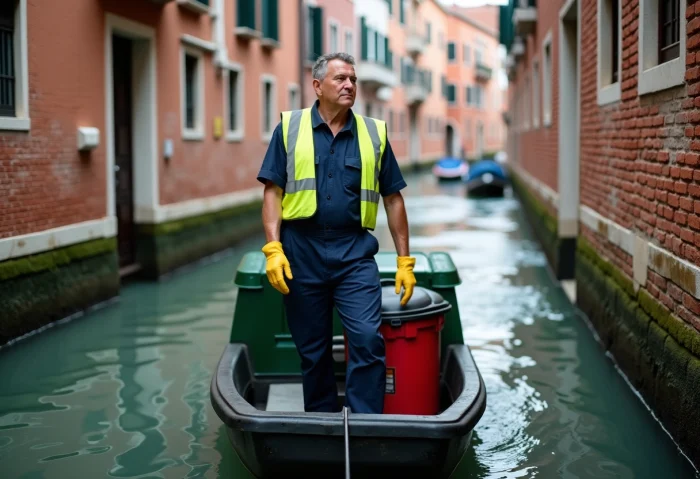
Every morning, a discreet army of 500 people, including garbage collectors, inspectors, and volunteer divers, is active long before sunrise. No trucks on the horizon: the narrow alleys and historic squares, led by St. Mark’s, necessitate the use of handcarts that glide between the sleeping palaces. Quickly, they reach the garbage boats, true floating arteries, to evacuate waste out of the city. By 10 a.m., the city must be spotless, ready to welcome the day’s influx of visitors.
Venice enforces strict waste sorting, divided into four categories: organic waste, paper-cardboard, glass-plastic-cans, and residuals. The collection schedule, under the close watch of Veritas and the city hall, dictates the rhythm. Residents and tourists must comply, under penalty of sanction. Bags pile up on the barges, heading to dry land, where they continue their journey in sorting centers, composting plants, or specialized facilities. A figure to measure the scale of the task: 55,000 tons of waste processed each year, at a cost that approaches one euro daily per household.
As for wastewater, the city faces a paradox: Venice does not have a traditional sewer system. Here, evacuation still partly depends on the tides. The acqua alta and drought episodes complicate management, exposing the lagoon to pollution. This issue repeatedly comes to the forefront of municipal discussions and inspires numerous documentaries, such as “Espèces d’ordures.” To shed light on the behind-the-scenes of this system and discover the proposed solutions, simply consult the investigation how Venice manages its waste.
Facing the pressures of climate change and relentless tourism, Venice reinvents itself every day. Rigorous waste sorting, recycling ensured by inmates, composting, underwater cleaning operations after floods: here, every initiative aims to preserve this fragile balance where water, history, and urban life intertwine without respite.
Venice facing its challenges: a laboratory city between tradition and innovation
Venice continually navigates its constraints. Waste management, far from being a detail, embodies this delicate alliance between heritage and constant adaptation. Every morning, cleanliness agents embark on a choreographed ballet. Handcarts and garbage boats ensure collection, while the city barely awakens. By the time tourists flood the alleys, everything must have vanished, as if by magic.
The sorting, imposed on everyone, is organized around four main streams: organic, paper-cardboard, glass-plastic-cans, and residuals. Under the watchful eye of Veritas, bags are deposited according to a precise schedule. The loaded barges leave the lagoon in the rhythm of a well-oiled machine, heading to sorting centers or composting sites. This organization, as meticulous as it is costly, amounts to nearly one euro per household per day.
For wastewater, the city has not yet severed all ties with its past. The absence of a conventional sewer system forces reliance on the tides to evacuate dirty water. Periods of acqua alta or drought complicate this fragile balance, putting the lagoon to the test. The sensitive subject fuels debates and inquiries. To delve deeper, the analysis “Wastewater Management in Venice: What Really Happens? – By Caroline and CO” offers detailed insights.
As Venice faces the threats of climate change and tourism, it establishes itself as a true laboratory. Mandatory sorting, innovative recycling initiatives, volunteer interventions: every action is part of a daily struggle to preserve the city and its waters.
The CNRS in Occitanie and the legacy of the 1893 World’s Fair: intersecting views on waste management
The Venetian morning, marked by waste collection, finds a surprising echo in French industrial memory. In Venice, nearly 500 agents, including garbage collectors, supervisors, and volunteer divers, coordinate their efforts to ensure the city’s cleanliness. Garbage boats navigate the canals, collecting waste sorted into specific categories: organic, residual, paper-cardboard, glass-plastic-cans. Everything is organized in a controlled circuit.
This rigor recalls a historical turning point observed in the south of France. The CNRS in Occitanie is interested in the technical legacy of the 1893 World’s Fair, which transformed the approach to industry, crafts, and waste management. The workshops highlighted at the time, such as spinning, weaving, and carpentry, already demonstrated the possibility of integrating waste recovery into production.
This intersection of scientific research and artisanal practices today inspires solutions tailored to cities with complex topographies. Composting plants for organic waste, recycling facilities for paper, cardboard, and glass extend the founding principle: every waste can become a resource.
Venice, like many French cities, relies on collective commitment. Strict adherence to sorting, combating incivility, with 450 fines in a year totaling 75,000 euros in penalties, or the involvement of inmates in recycling museum banners, illustrate this desire to combine innovation, transmission, and responsibility to tackle the challenges posed by waste and wastewater.

Eco-responsibility and scientific research: what solutions for a sustainable future in fragile cities?
In Venice, the balance of the natural environment requires constant attention. Inscribed on the UNESCO World Heritage list, the city must contend with two major threats: the rising Adriatic, plus 19 centimeters in a century, and the unrelenting pressure of tourism. Episodes of acqua alta are multiplying, threatening both marine biodiversity and centuries-old infrastructure.
To address this, the municipality and Veritas orchestrate rigorous waste sorting. Here’s how the streams are distributed:
- Organic waste goes to composting, valued to nourish new lands.
- Paper, cardboard, glass, plastics, and cans enter recycling streams.
- Residuals are directed to specialized plants to limit their environmental impact.
This organization mobilizes nearly 500 people daily for manual collection, supported by a fleet of garbage boats. After floods, volunteer divers descend to clean the bottoms, proof of a collective commitment that goes beyond mere daily management.
But the city does not just act in urgency. With the support of scientific research, it tackles broader issues: water quality, impact on aquatic species, reduction of chemical pollution. Massimiliano de Martin, deputy for the environment, advocates for a holistic approach, involving residents, researchers, and institutions in a common dynamic.
Venice constantly reminds us that preserving urban life in a fragile environment requires rigor and imagination. Here, the survival of the lagoon depends on every decision, every outstretched hand, and the ability to continually reinvent the gestures of everyday life.