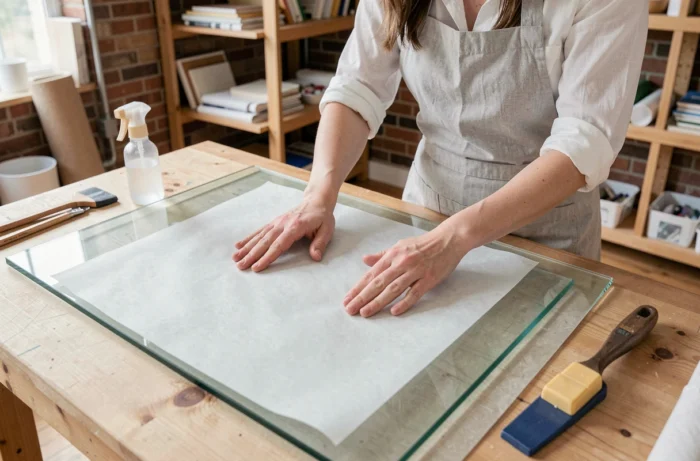
Tracing paper is a translucent material whose lightweight and smooth surface make it sensitive to air bubbles when placed on glass. This difficulty arises from the interaction of two non-porous surfaces: glass, which is perfectly smooth and impermeable, and tracing paper, which is minimally absorbent. Any irregularity, dust, or excess glue traps air between the two layers. To achieve a clean result, the preparation work is as important as the application gesture.
Why tracing paper traps bubbles on glass
When a conventional fibrous paper absorbs some of the glue, tracing paper does not. The adhesive remains on the surface and forms a wet film between two impermeable materials. If the layer of glue is uneven or too thick, air becomes trapped with no escape.
Condensation exacerbates the problem. A sheet of tracing paper placed directly against a window, especially in a humid room, can accumulate water vapor at the interface. This moisture distorts the paper and creates new pockets. For tracing paper intended to stay behind glass for a long time, leaving an air gap with a mat or spacer reduces this risk.
Dust and grease marks on the glass are another common cause. Even a microscopic grain of dust is enough to locally lift the tracing paper and initiate a bubble that expands during smoothing. A detailed method has been published on the Future au Féminin website, which also emphasizes this preliminary cleaning step.

Preparing the glass surface before gluing
Preparation is the least spectacular part of the project, but it determines success. A clean, dry glass eliminates most causes of bubbles.
Cleaning and degreasing the glass
Use a lint-free cloth soaked in household alcohol or white vinegar. Wipe the entire surface in a single circular motion, then dry with a second dry cloth. Labeling recommendations on glass confirm that dirt, grease, and moisture compromise adhesion.
Wait for the surface to be completely dry before applying anything. Working in a temperate and low-humidity room facilitates drying and limits subsequent condensation.
Preparing the tracing paper
Cut the tracing paper to the final dimensions before touching the glue. Handle it by the edges to avoid fingerprints, which create greasy areas where the adhesive does not adhere well. If the tracing paper has been stored rolled, flatten it under a heavy book for an hour: crumpled paper traps air as soon as it is applied.
Choosing glue for tracing paper on glass
Not all adhesives are suitable. Since tracing paper is thin and translucent, an opaque or too thick glue will be visible through it. Three main types work, each with its limitations.
- Repositionable spray adhesive: it applies a thin, even layer, reducing the risk of excess thickness. Repositionable sprays allow you to lift and reposition the tracing paper in the first few seconds, a decisive advantage for correcting a bubble. Always test on a scrap of tracing paper before treating the final piece, as some sprays dry faster than expected.
- Diluted vinyl glue (like white glue thinned with water): applied with a wide brush in a very thin layer, it gives a discreet finish once dry. The main risk is the wrinkling of the tracing paper if the layer is too wet.
- Extra-thin double-sided tape: placed around the edges of the tracing paper, it prevents any contact of wet glue with the visible surface. The result is clean, but the hold in the center of the tracing paper depends solely on the tension of the paper.
For tracing paper with sentimental value or an original drawing, conservation specialists recommend reversible fixings, such as Japanese paper hinges glued with starch paste, rather than full adhesion. This approach allows for the tracing paper to be removed later without tearing.
Application technique for tracing paper without bubbles
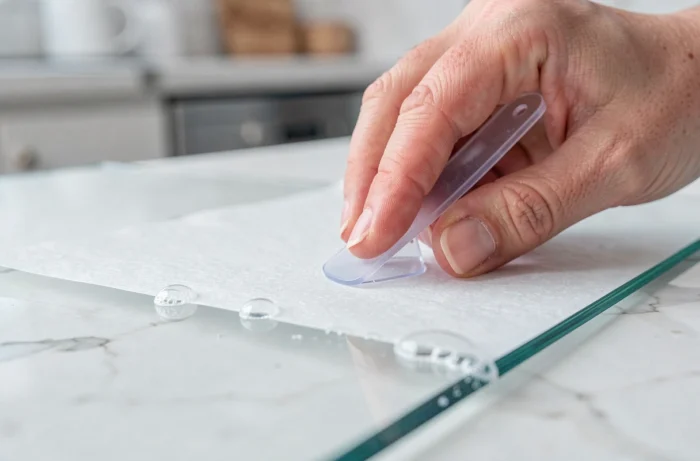
The application gesture follows a simple logic: place on one side, then gradually push the air towards the opposite side, without ever pressing the tracing paper down all at once over the entire surface.
Apply by progressive sweeping
Align one edge of the tracing paper with one edge of the glass. Hold it slightly raised with one hand. With the other, press with a rigid card (expired credit card, plastic spatula) from the placed edge towards the free edge, in a slow and steady motion.
Each pass of the card should overlap the previous one to leave no un-smoothed area. Work in small strokes rather than one long sweep: control is better.
Correcting an already formed bubble
If a bubble appears, do not pierce it immediately. With a repositionable spray, you can gently lift the tracing paper up to the bubble and resume smoothing. With still-wet vinyl glue, the same maneuver works as long as you act quickly.
On already dry glue, the bubble can be pierced with the tip of a fine needle, then pushed out with the card towards the hole. The result is acceptable on decorative tracing paper but not recommended on a document you wish to keep intact.
Common mistakes to avoid when gluing on glass
- Applying glue directly on the tracing paper instead of on the glass: the tracing paper wrinkles, distorts, and becomes impossible to smooth properly. Always apply the adhesive to the glass first.
- Using a permanent spray instead of a repositionable one: without the possibility of correction, even the slightest bubble is permanent. Product sheets for sprays clearly distinguish these two categories, so check the label.
- Working in a cold or humid room: tracing paper distorts in humid conditions, and condensation on the glass negates the surface preparation.
The choice between full adhesion and perimeter fixing depends on the final use. A tracing paper fully glued to the glass provides a better visual effect (no central air pocket), but it becomes nearly impossible to remove cleanly. For temporary decoration or a tracing paper you care about, edge double-sided tape or Japanese hinges offer a solid compromise between hold and reversibility.