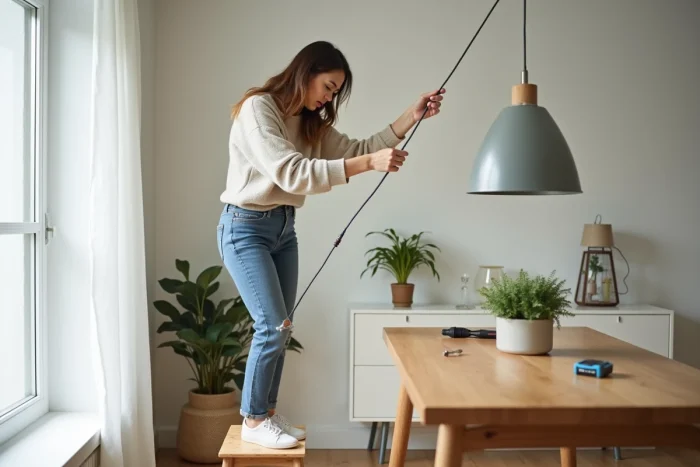
The standard length of light fixture wires often exceeds what is necessary, requiring unexpected adjustments during installation. Some manufacturers provide built-in adjustment systems, while others make any modification more complex, even risky if done incorrectly.
There are simple methods to adapt an overly long fixture without calling in a professional. A few basic tools are sufficient, provided that precise guidelines are followed to ensure the safety and compliance of the installation.
When an overly long fixture becomes an issue: understanding the stakes and solutions
A hanging light that hangs too low radically changes the perception of a room. Visually, it is the off-note that stands out. In everyday life, it is an obstacle that hinders movement, especially in a dining room or above a table where circulation is crucial. If it hangs too low, it can dazzle or become the cumbersome guest that one avoids looking at. In a bedroom, a wire that hangs too far from the ceiling intrudes into the decor, disrupts the balance of the room, and ultimately takes up too much mental space.
Visible wires, whether too prominent or poorly tensioned, detract from the atmosphere of an interior, whether it is art deco, vintage, or contemporary. The right length for a pendant light is not just a matter of style: it affects the orientation of light, its reach over a table or a desk corner, and the ease of living in the living room or kitchen. It is the balance between practicality and harmony that is at stake.
To adapt a fixture, several options exist. Here are the most common:
- Adjust the cable at the junction of the ceiling, adapting the height using the rose.
- Trim the wire in configurations that allow it.
- Use an adjustment kit for slightly more technical models.
No improvisation is allowed: each manipulation requires following a strict method. It is wise to consult Place A’s resources where clear tutorials and step-by-step adjustment tips make it easier to get started.
Each situation has its specifics: ceiling light in the living room, vintage pendant above the dining table, art deco chandelier in the kitchen… The nature of the cable, the strength of the wire, the compatibility with the ceiling fixture: these are all parameters to examine carefully. Here, there is no room for approximation.
What methods to choose for easily shortening a light fixture wire?
Different solutions are at hand to adapt the cable length of a hanging light, depending on the model and type of ceiling encountered. The simplest and most common method involves intervening just below the rose: simply disassemble the piece, slide the excess wire inside, and then close it up. There is no need to cut anything, the original wire remains intact, the result is clean, and the installation is preserved.
However, some fixtures require more action. If the rose cannot accommodate the excess, or if the hanging wire remains too visible, cutting is necessary. Using cutting pliers, remove the surplus, strip the ends, and make a clean connection with a connector. Insulation with tape is imperative: it is the detail that ensures the safety of the connection.
Some models, particularly LED ceiling lights or vintage pendants, benefit from specific shortening kits. They facilitate adjustment and are easy to install, provided that the instructions are followed carefully.
Here are three ways to proceed depending on the context:
- Slide the wire into the rose, ideal for lightweight pendants.
- Trim and connect methodically for longer or bulkier cables.
- Use a dedicated kit suitable for certain LED ceiling lights.
Each room has its logic: above a worktop in the kitchen, in a living room with an art deco chandelier, or in the dining room, the technique must adapt to the space and the desired aesthetic.

Practical steps and tips for successfully adjusting safely
Proceed step by step, without compromising on safety
Before touching the fixture, start by turning off the electricity at the circuit breaker. This simple reflex eliminates unnecessary risks. To check that the current is no longer flowing, use a reliable electrical tester. Caution is key, even if the manipulation seems trivial.
Continue by disassembling the ceiling rose to access the hanging wire. If the length exceeds what you want, you have two choices: slide the excess cable inside the rose, or, if that is not possible, trim the wire to the desired length. Use well-sharpened cutting pliers, carefully strip the ends to prepare a clean connection.
To ensure the safety and reliability of the adjustment, adhere to the following points:
- Make connections with a quality connector that meets current electrical standards.
- Insulate each connection with electrical tape to prevent any accidental contact.
- Ensure that the ceiling fixture is secure, especially in children’s rooms or bathrooms where vigilance is even more important.
Anticipate needs and comply with regulations
In sensitive areas, protective sheathing remains essential to encase the cables, especially against humidity or shock risks. Any doubt about the compliance of your installation justifies consulting an electrician. Whether it’s a kitchen ceiling light, a vintage pendant, or an art deco chandelier, rigor and method are the only guarantees of a reliable and durable installation. Here, there is no room for approximation: it is better to carry out a thoughtful manipulation than a hasty adjustment. Shortening a light fixture wire is to offer the room the detail that changes everything, without ever compromising on safety.