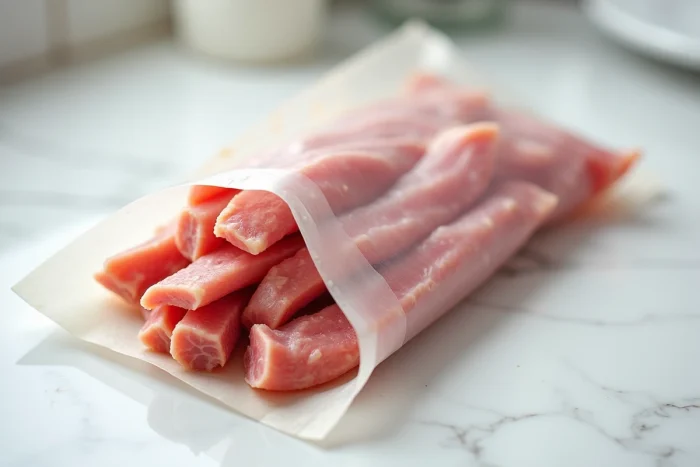
Bacon bits are a raw or partially cooked charcuterie, packaged under a protective atmosphere. This atmosphere slows down bacterial development but does not stop it. Once the tray is opened or the expiration date (DLC) is exceeded, the product enters a zone of real health risk, particularly regarding Salmonella and Listeria.
Batch number and DLC of bacon bits: two distinct checks
Most consumers rely solely on the date printed on the packaging. The DLC sets a limit beyond which the manufacturer no longer guarantees the product’s safety. For bacon bits, this date is short, generally a few weeks after packaging.
The date alone is not enough. Recent recalls of Herta smoked bacon bits contaminated with salmonella show that only part of the production may be affected, even when the DLC is the same on other trays. The batch number, printed next to the date, allows for the precise identification of products affected by a manufacturing defect or contamination.
Before cooking bacon bits, checking the DLC and the batch number on official recall sites is a more reliable reflex than relying on one’s senses. To know how to tell if bacon bits are still good, this information should be cross-referenced with a sensory examination of the product.
Visual and olfactory signs of expired bacon bits

Sensory examination remains a useful complement to checking the date. Three indicators help assess the condition of bacon bits before cooking.
Color and appearance of the meat
Fresh bacon bits have a uniform pink color, with white or slightly translucent fatty parts. When the meat turns gray, brown, or greenish, degradation has begun. A slimy film on the surface, sticky to the touch, indicates advanced bacterial proliferation.
Odor upon opening the tray
A slight smoky or charcuterie smell is normal. However, a sour, acidic, or distinctly unpleasant odor indicates that bacteria have colonized the product. This sign is often the most reliable for deciding to discard the tray.
Condition of the packaging
An abnormally swollen protective atmosphere packaging indicates gas production by microorganisms. This swelling is a clear warning signal, even if the DLC has not yet been reached.
- Swollen or bulging tray: discard without opening, the gas comes from bacterial activity
- Punctured or poorly sealed plastic film: the protective atmosphere is broken, preservation is no longer guaranteed
- Presence of cloudy or yellowish liquid at the bottom of the tray: sign of protein degradation
Limits of smell and visual inspection: what the senses cannot detect
A virologist quoted by Marmiton warns against excessive trust in smell and visual appearance. Some pathogenic bacteria, such as Salmonella, do not alter the smell or appearance of the product. Bacon bits may appear perfectly normal and harbor dangerous contamination.
The national recall of Herta smoked bacon bits contaminated with salmonella illustrates this problem. The affected trays showed no visible signs of alteration. Only traceability (batch number, distribution brand) allowed them to be identified.
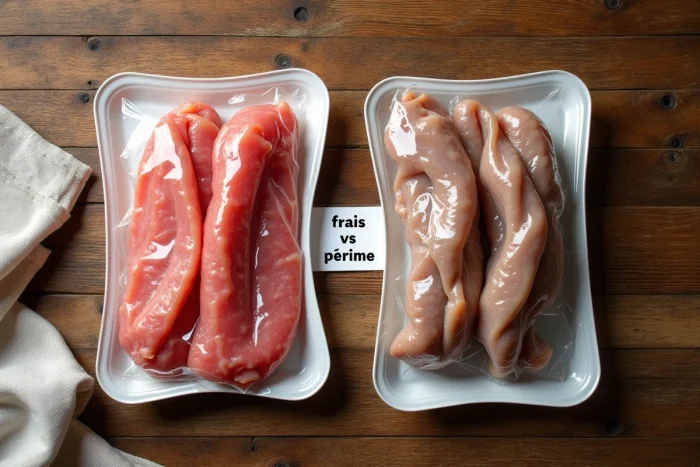
This distinction between visible alteration and invisible contamination is fundamental. The absence of suspicious signs does not guarantee the product’s safety. The senses serve to eliminate obvious cases, not to validate the safety of a food.
Storage and cooking of bacon bits: reducing bacterial risk
The cold chain determines the shelf life of bacon bits. An opened tray should be consumed quickly, ideally within two days, while keeping it in the refrigerator in a closed container.
- Never refreeze bacon bits that have already been thawed: the freeze-thaw cycle promotes bacterial multiplication
- Do not freeze a suspicious or recalled batch for later consumption: freezing does not kill pathogenic bacteria, it puts them on hold
- Bacon bits left out of the refrigerator for several hours should be discarded, even if their appearance remains normal
Cooking as a sanitary barrier
Salmonella is destroyed at an internal temperature of around 65 °C maintained long enough. Well-grilled bacon bits significantly reduce the risk of infection. Cooking does not compensate for a clearly spoiled product (strong odor, slimy texture), but it serves as an effective barrier against invisible contaminations on a product whose date and appearance are correct.
Cooking bacon bits in a pan until they are golden and crispy is usually sufficient to reach this temperature. Preparations where the bacon bits are barely seared (lightly cooked quiches, warm salads) present a higher risk if the product is approaching its DLC.
Checking the expiration date, the batch number, and the sensory state forms a complementary control trio. None of these three elements is sufficient alone. A product within the time frame, without a recalled batch, with normal color and smell, cooked through: it is the combination of these four conditions that makes bacon bits safe to consume.