
Retirement alters family dynamics far beyond just a change in daily rhythm. Today’s seniors no longer settle for a passive role within the household: they pass on skills, support their grandchildren, and increasingly become caregivers for their own parents. This overlap of roles creates unprecedented family dynamics, where fulfillment depends less on generic recipes and more on concrete trade-offs between personal commitment and self-preservation.
Senior caregivers: the dual role that strains family life
Among the most demanding situations are those of retirees who assist an elderly parent while maintaining their own couple’s life and connections with children and grandchildren. Institutional resources are increasingly addressing these aged caregivers facing the risk of burnout, a sign of recent awareness.
The most common conflict revolves around the division of tasks among siblings. When a retiree takes on the sole responsibility of caring for a dependent parent, the burden encroaches on their marital life and the time they dedicate to their grandchildren. Field reports vary on this point: some families find balance through rotating responsibilities, while others see tensions settle in for the long haul.
Several concrete guidelines can alleviate pressure on family caregivers, in addition to the information available on the Seniors des Infos for the family website:
- Formalize a schedule of support among siblings, even if imperfect, to prevent the burden from resting on a single person
- Identify early home assistance options (home helpers, meal delivery) that free up time without guilt
- Preserve at least one couple’s activity or personal hobby per week, even when the situation of the assisted parent seems priority
Intergenerational activities: passing on skills rather than time
Existing content emphasizes the frequency of visits and the regularity of calls. This quantitative approach overlooks a more powerful lever for family fulfillment: the active transmission of know-how between grandparents and grandchildren.
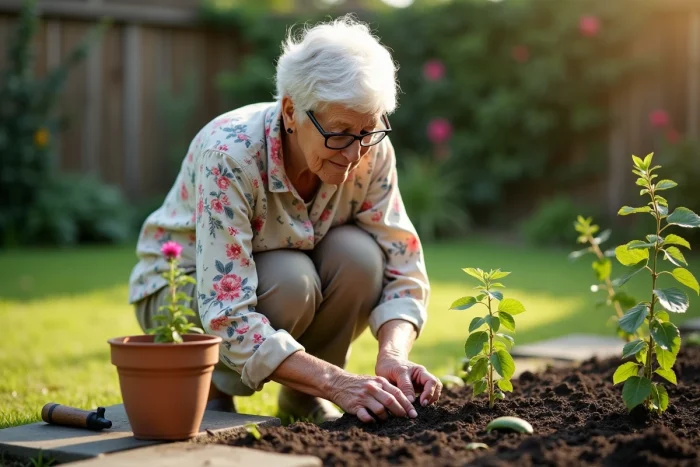
A retiree teaching woodworking, gardening, or cooking to a teenager is not just filling an afternoon. They are building a shared project that enhances the self-esteem of both parties. Seniors engaged in structured intergenerational projects report a significantly higher sense of usefulness than those who settle for courtesy visits.
The difference lies in the chosen nature of the activity. Participating in a bike repair workshop with a grandson does not have the same effect as a Sunday lunch out of obligation. Freely chosen activities generate a positive model for children and give the senior an active role in the family, distinct from that of a person to be protected.
Finding the right format according to autonomy
Physical health determines the type of project that can be realized. A mobile senior can supervise a shared vegetable garden or accompany a nature outing. In cases of reduced mobility, manual activities at home (sewing, modeling, cooking) or digital exchanges (video calls around a photo album, for example) remain accessible.
The challenge is not to multiply opportunities, but to choose a regular activity that has meaning for both generations. A single monthly meeting around a concrete project is worth more than frequent visits without shared content.
Digital tools and family connections among seniors
Video conferencing, instant messaging, and social networks have changed the way families stay connected. For seniors, mastering these tools directly affects the quality of their connection with geographically distant loved ones.
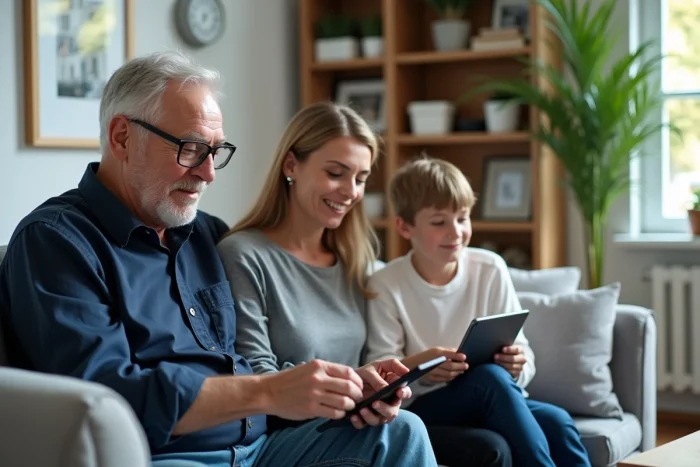
Digital training for retirees is expanding in libraries, community centers, and some associations. Learning to use a tablet for video calls or sharing photos is no longer a gadget: it has become a direct factor in maintaining social and family ties.
However, digital tools do not replace physical presence. Video exchanges do not replicate all the effects of in-person contact on psychological well-being. Families relying solely on digital means risk confusing the frequency of communication with relational quality.
Some practical guidelines
Prefer a single well-mastered tool (one messaging app, one family social network) rather than dispersing exchanges across multiple platforms. The goal is to reduce the cognitive load associated with technology so that the tool remains a means, not an obstacle.
Involving grandchildren in learning reverses the usual dynamic: the teenager who helps their grandparent set up a tablet experiences a moment of reverse transmission, strengthening the bond through cooperation.
Health and autonomy: preserving family balance over time
A fulfilling family life among seniors relies on a condition often underestimated: maintaining sufficient physical autonomy to remain an active participant in family relationships. Adapted physical activities (walking, gentle gymnastics, swimming) directly contribute to this autonomy, not as an abstract medical goal, but as a concrete prerequisite for continuing to participate in family life.
A senior who retains their mobility can host their grandchildren at home, travel for a family meal, or participate in a group outing. Conversely, loss of autonomy gradually shifts the senior’s role to that of a supported person, altering the relational dynamics within the family.
Daily habits play a crucial role here. According to available summaries on healthy aging, simple habits (regular physical activity, balanced diet, maintaining an active social life) influence the quality of aging more than genetic factors alone.
The family fulfillment of seniors is not decreed by a list of best practices. It is built in the interplay between chosen roles (transmitting, sharing, creating), the lucid management of constraints (health, caregiver burden, geographical distance), and the ability to ask for support when the situation demands it. Accepting this help remains, for many retirees, the most concrete step towards sustainable family balance.