
The French video game market is hiring, and training programs are multiplying to meet this demand. Specialized schools in game design, university courses in computer science, BTS, professional licenses: the pathways leading to the video game industry have never been so numerous. However, the promises differ depending on the chosen field, and the value of the obtained diploma varies widely.
Before committing to three to five years of study, it’s essential to understand what each option truly teaches, what it overlooks, and how the job market treats its graduates.
RNCP Accreditation and Recognition of Video Game Schools
One point often underestimated by candidates concerns the official recognition of the diploma. Traditional computer science programs (bachelor’s, master’s, engineering diploma) have long benefited from state accreditation, which facilitates access to public funding and work-study programs.
On the side of private video game schools, the situation has evolved. Since 2024, RNCP accreditations are multiplying for private video game training programs, according to available data. This trend strengthens their legitimacy with employers and opens the door to work-study programs, a funding lever that students cannot ignore when tuition fees exceed several thousand euros per year.
To choose between a video game school and a traditional program, checking RNCP registration serves as a first concrete filter. A non-referenced program does not grant access to the same rights, particularly regarding apprenticeship contracts or coverage by an OPCO.
Accreditation does not guarantee pedagogical quality, but its absence is a serious warning signal.

Game Design Training and Generative AI: A Shift That Universities Are Slow to Embrace
The integration of artificial intelligence into video game creation is reshaping the skills expected by studios. Procedural level generation, assisted animation, rapid prototyping of game mechanics: generative AI is transforming the daily lives of developers and game designers.
Since 2025, public funds are financing hybrid AI and video game training programs, benefiting specialized schools that can quickly adapt their curricula. Traditional computer science programs, of course, incorporate AI into their teachings, but from a more theoretical perspective (machine learning, statistics, algorithms) without direct application to game design.
The difference is evident on the ground. In a specialized school, a first-year student can already manipulate tools for generating 3D assets or assisted level design. In a computer science bachelor’s program, these applications rarely appear before the master’s level, if they appear at all.
Field feedback varies on this point: some studio recruiters prefer a profile that masters algorithmic fundamentals, even if it means training internally on AI tools. Others prioritize candidates who are operational from day one.
Retention in the Video Game Industry: Which Program Retains Its Graduates
One indicator rarely discussed in training brochures concerns the duration that graduates remain in the video game industry after their first job. According to the Syntec Numérique study “Employment and Skills in Video Games 2025,” based on 1,200 surveys from French studios, the departure rate of graduates from video game schools has decreased by 15% compared to traditional computer scientists.
The explanation lies in the simulated studio projects from the first year. Students work in teams on a complete production cycle (concept, prototype, test, iteration), which reduces the gap between expectations and the reality of the job.
In contrast, graduates from traditional computer science programs who enter the video game industry sometimes do so without fully understanding the specific constraints of the sector: crunch, lower salaries compared to other areas of tech, and precarious contracts in small studios. The cultural shock leads to quick departures to fintech, consulting, or cybersecurity.
Career Transition to Defense and Cybersecurity
The ANSSI report “Cybersecurity Trends 2026” highlights a recent phenomenon: demand is increasing for “converted game devs” in military simulation. Skills in real-time 3D rendering, physics engines, and graphical optimization find opportunities in defense, immersive training, and cybersecurity.
Graduates from traditional computer science programs have easier access to these pathways because their training covers fundamentals in networks, systems, and security. A graduate from a video game school will generally need to enhance their profile to qualify.
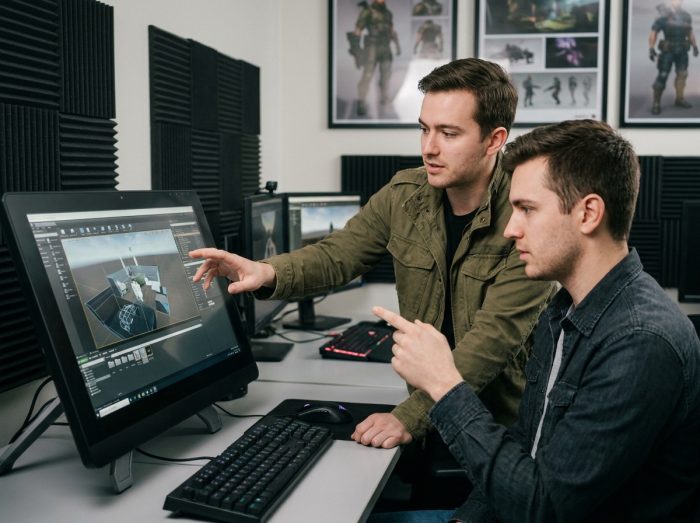
Concrete Criteria for Choosing Between Specialized School and Computer Science Program
Rather than an abstract list of “pros” and “cons,” here are the questions to consider before enrolling:
- Is the targeted diploma registered with the RNCP and does it grant access to work-study programs, significantly reducing the total cost of training?
- Does the program integrate multidisciplinary team projects (game design, animation, development, sound) from the first year, or does it rely on lectures until the master’s level?
- Are the instructors active professionals in studios, or exclusively teacher-researchers?
- Is the alumni network active in the video game sector, and do internships lead to documented hires?
A student aiming for a gameplay programmer position in a AAA studio will likely find satisfaction in a specialized school with a strong professional network. A student who is torn between video games and other areas of tech should prioritize a traditional computer science program, which is more versatile.
The versatility of a traditional program offers better protection against market fluctuations. The video game sector remains cyclical, with waves of layoffs even in large studios. Having a recognized diploma in general computer science provides a safety net that pure specialization does not guarantee.
The final choice depends less on displayed prestige than on the coherence between the program, professional project, and the student’s financial capacity. A verified RNCP, documented studio projects, and an active alumni network weigh more heavily than a photogenic campus.