Fashion trends refer to the stylistic directions (cuts, materials, colors, prints) adopted by designers during Fashion Weeks and translated into wearable pieces by ready-to-wear. This season, these orientations are viewed through a double lens: the usual aesthetic renewal and a French regulatory framework that concretely alters how garments are produced, sold, and labeled.
Anti-fast fashion law and eco-contribution: what changes for shopping this season
Since September 1, 2026, law n° 2026-602 of July 8, 2026, regulates what the legislator calls ultra-fast fashion. The definition combines two criteria: a large number of new references put on sale and a low incentive for product repair.
In practice, the concerned brands see their eco-contribution adjusted, which increases the production cost of the least durable pieces. Starting January 1, 2027, advertising for these players will be prohibited.
For buyers, the direct consequence is a shift in the comparison between brands. The displayed price is no longer sufficient: the Ecobalyse tool, whose use was expanded in October 2026, now allows measuring the environmental impact of a garment before purchase. Cross-referencing the guides on fashion and trends on Toujours Le Bon Choix with this environmental display provides a more comprehensive view of a piece’s real value.

Key materials and prints for the autumn-winter season
The Parisian fashion shows confirmed several textile directions that are already appearing in stores. Heavy materials (felted wool, corduroy, grained leather) dominate the wardrobes offered for autumn-winter, with a marked preference for textures that are visible to the touch as well as to the eye.
Colors and patterns to note
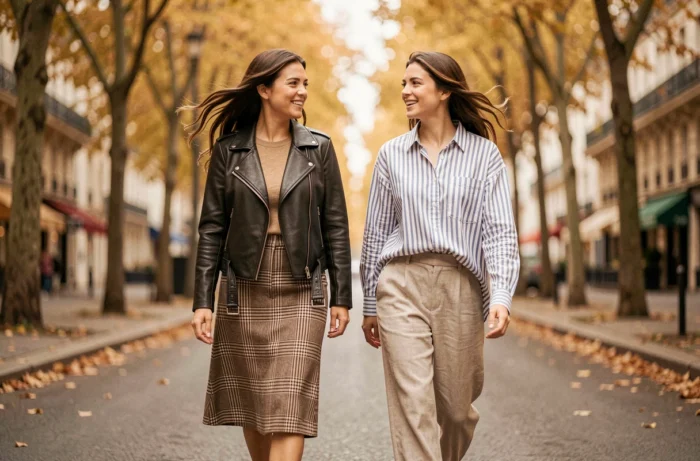
The palettes fluctuate between muted tones (deep burgundy, fir green, chocolate brown) and occasional bursts of bright colors used in accessories or as a standout piece in a look. Animal prints remain present, particularly leopard, which is featured on various supports: fluid shirts, midi skirts, scarves.
Wide stripes and abstract geometric patterns complete the picture. The graphic trend works particularly well on knits, where jacquard is making a strong comeback.
Three materials defining this season’s looks
- Thick, raw denim, worn as a total look or mixed with more dressed-up pieces (structured blazer, heeled ankle boots). The barrel jean, with its loose fit at the hips and tapered at the ankle, remains the reference denim silhouette.
- Ribbed knit in merino wool or recycled cashmere, favored for oversized sweaters that are a staple of the autumn wardrobe. Choosing a sufficiently dense weight ensures the garment holds up after multiple washes.
- Soft leather (or its plant-based alternatives), used for short jackets and straight skirts. The lining and seam finishes remain the best indicators of durability for this type of piece.
Building a personal style beyond seasonal trends
Following fashion trends does not mean renewing your entire wardrobe. A functional wardrobe is based on a foundation of timeless pieces (trench coat, well-cut jeans, white shirt, solid-colored sweater) to which one adds one or two seasonal pieces.
The principle is arithmetic: if the majority of worn pieces are neutral in cut and color, a single strong element (a leopard print, a colorful short jacket, a structuring accessory) is enough to anchor the look in the current season.
Concrete criteria for evaluating a trendy piece before purchase
- Check the composition: a high percentage of natural or recycled fibers, visible on the label, generally indicates better longevity.
- Test compatibility with at least three outfits already present in the wardrobe. A piece that only works with one look will quickly be abandoned.
- Consult the environmental display when available. Since the expansion of Ecobalyse, comparing two similar garments based on their actual impact is now possible directly online.
- Prefer cuts that suit your morphology rather than the current silhouette. Wide trousers may suit some body types but not all, and the trend does not change this reality.
Brand transparency: reading beyond trendy marketing
French regulations now require fashion platforms to provide more information at the time of purchase. This obligation alters the relationship between usual style guides and actual purchasing decisions.
In practice, environmental labeling shifts the comparison between brands. Two ribbed knit sweaters offered at the same price can display very different scores depending on the place of manufacture, transportation, composition, and recyclability. This data, absent from traditional fashion magazines, becomes a choice criterion as legitimate as cut or color.
The modulation of the eco-contribution outlined in the July 2026 law will gradually impact prices. Pieces made by actors classified as “ultra-fast fashion” will be more expensive to produce, which could reduce the price gap with brands positioned on more reasonable volumes.
This season’s fashion trends are therefore read on two simultaneous levels: aesthetic choices (heavy materials, graphic prints, autumn palettes) and the new regulatory framework that makes each purchase a bit more traceable. Keeping both in mind when composing autumn-winter looks allows for buying less but with more precision.