
You order a top online, hesitating between M and L, and you choose M out of habit. The package arrives, and the fabric pulls at the shoulders. The garment goes back into the box. This scenario repeats itself every season because the choice between these two sizes is based on much more than the letter printed on the label.
Actual difference between size M and size L depending on the type of garment
The letter M stands for “Medium” and the letter L stands for “Large.” So far, so simple. What is less straightforward is that the difference between M and L varies from brand to brand, sometimes surprisingly.
On a basic t-shirt, the difference often lies in the chest circumference and the length of the torso. On pants, it’s the waist and hip measurements that change. On a structured jacket, the shoulder width also comes into play.
Fast-fashion brands tend to offer more generous M and L cuts than a few years ago, in response to a growing demand for inclusive sizing. This means that a current M may correspond to an old L at the same brand. To truly understand the difference between size L and M, you need to think in centimeters, not letters.
A rarely discussed point: Asian sizes M and L are significantly narrower than European standards. When shopping on cross-border sites, an Asian L may correspond to a French M, which leads to a very high return rate on these orders.

Chest circumference, waist circumference, hip circumference: the measurements that matter
Have you ever noticed that two people wearing the same size can have very different silhouettes? This is because the size printed on the label is a compromise between three main measurements.
Taking your measurements with a measuring tape
Get a flexible measuring tape. Place it directly on your skin, without tightening, at three locations:
- Chest circumference: at the fullest part of the bust, under the armpits and across the shoulder blades.
- Waist circumference: at the natural dip, between the lower ribs and the navel. Exhale normally before reading the measurement.
- Hip circumference: at the widest part of the hips, encompassing the buttocks.
Note these three numbers. They are your stable reference, independent of any brand.
Comparing your measurements to the brand’s size chart
Every reputable site publishes a size guide with ranges in centimeters. If your chest measurement falls within the M range but your hip measurement corresponds to L, there are two approaches. For a top, rely on the chest measurement. For bottoms, prioritize the hip measurement. If in doubt between two sizes, choose the larger one: altering a slightly loose garment is always easier than forcing a too-tight fit.
Garment cut and fabric: what the letter doesn’t tell you
An M in structured linen and an M in stretchy jersey do not fall the same way at all. The letter on the label does not take into account the elasticity of the fabric or the cut intended by the designer.
A garment described as “straight cut” or “regular fit” follows the measurements in the chart quite faithfully. An “oversize” model is designed to be worn loose: sticking to your usual size is sufficient, no need to go up to L. Conversely, a “slim” or “fitted” cut is tighter. If your measurements are at the top of the M range, moving to L will avoid the unwanted “second skin” effect.
A fabric containing elastane allows for a discrepancy of one or two centimeters. A 100% woven cotton fabric does not. Check the composition before confirming your cart.
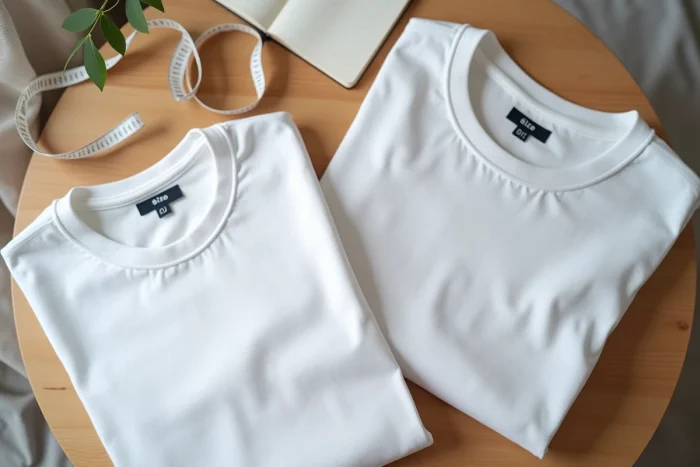
Self-confidence and online shopping: the psychological impact of choosing M or L
Why do so many people prefer to order an M rather than an L, even when their measurements clearly lean towards L? The answer goes beyond the fabric issue.
The size printed on a label functions as an identity signal. Wearing M is reassuring because the letter seems more “standard.” Moving up to L can be perceived as an admission, a regression. This mechanism drives people to choose the smaller size, even if it means receiving an uncomfortable garment.
Online, the phenomenon amplifies. Impossible to try on, impossible to check the fit on oneself. Doubt about size generates anxiety that hinders purchase or increases returns. Some brands have understood this and are starting to integrate interactive visuals to compare sizes on different body types.
The healthiest reflex is to dissociate the letter from self-image. A well-cut L that fits perfectly on your shoulders will always flatter you more than an M that pulls and wrinkles. The right size is the one in which you move freely.
Quick method to choose between M and L before ordering
Before clicking “add to cart,” go through this three-step check:
- Take your three measurements (chest, waist, hips) with a flexible tape directly on your skin.
- Compare each measurement to the size guide of the brand in question, not to a generic chart found elsewhere.
- Identify the cut (fitted, straight, oversize) and the fabric composition (presence or absence of elastane) to adjust your choice.
If two of your three measurements fall within the L range, take the L. If they are all in M, take the M. If it’s mixed, the cut of the garment and the fabric will help you decide.
One last point to keep in mind: size guides evolve. A brand you knew well two years ago may have adjusted its patterns since. Taking your measurements and checking the chart with each order remains the most reliable way to avoid the return box.